


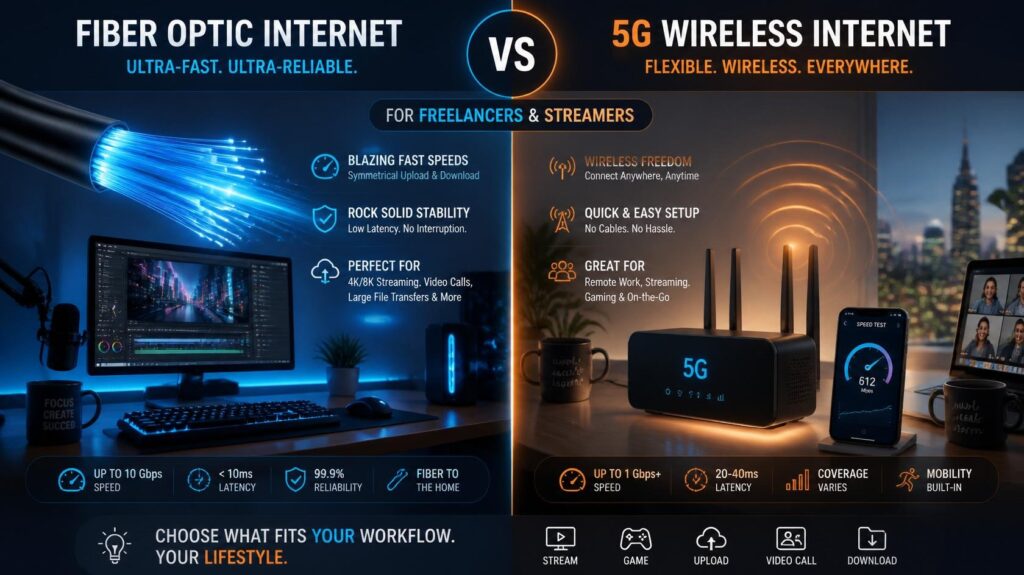
If you are working online, downloading heavy files, or managing a website like Solutionodex, a stable internet connection is your backbone. But when setting up your home office, you face a major decision: Should you get a physical Fiber Optic vs 5G broadband line or rely on a wireless 5G home device?
Choosing between Fiber Optic vs 5G determines your daily workflow, speed consistency, and monthly expenses. Let’s look at the absolute ground realities of Fiber Optic vs 5G so you can pick the best setup for your online work.
1. Fiber Optic Broadband The Speed & Stability Standard
Fiber Optic uses physical glass cables pulled directly into your home router. It is the gold standard for heavy internet users, developers, and online workers who need 100% uptime and consistent bandwidth.
Key Advantages:
- Truly Unlimited Data: You can download heavy files, perform website backups, or stream 4K content all day without worrying about data caps or extra charges.
- Low Ping and Latency: Fiber offers exceptionally low latency. If you host live video calls, manage remote servers, or play online games, low ping ensures zero lag.
- Symmetrical Speeds: You get equal upload and download speeds, which is crucial when uploading large media assets or site backups to servers like Hostinger.
The Main Catch:
It is strictly tied to a physical wire. If a local construction crew accidentally cuts the cable on the street, your connection goes dead until a technical team manually repairs it. Additionally, if power goes out and you don’t have a UPS for your router, the internet turns off instantly.
2. 5G Home Wireless Devices Unmatched Portability & Backup
Wireless data routers run on cellular mobile networks. You just slide in a data SIM, power it on, and you are ready to go.
- Battery Power & Portability: Most wireless devices have internal batteries. When electricity goes out, your net keeps running for hours. Plus, you can pack it in your bag and work from anywhere.
- Zero Installation Hassle: No technicians drilling holes in your walls or running long wires. You buy the SIM, activate a bundle, and it works instantly.
- The Main Catch: Strictly limited packages (like 100GB or 150GB per month). If you stream heavy video content, your package can finish in days. Also, speeds can drop during evening peak hours when everyone in your neighborhood logs onto their phones.
Fiber Optic vs 5G Quick Comparison Table
| Feature | Fiber Optic Broadband | 5G Wireless Home Device |
| Data Limit | Truly Unlimited | Strict Monthly Caps (100-200GB) |
| Speed Stability | Highly Stable & Fixed | Fluctuates based on Signals & Network Load |
| Latency (Ping) | Very Low (Best for calls & live tasks) | Moderate to High |
| Power Dependency | Needs Router UPS during outages | Built-in Battery Backup |
| Mobility | Tied to Home/Office | Fully Portable (Work anywhere) |
3. The Final Verdict Why You Need a Dual Setup
When deciding between Fiber Optic vs 5G, relying solely on one connection type can introduce major operational risks to your workflow. Both technologies excel in distinct environments, but they also carry fundamental vulnerabilities if used in isolation. To make an informed financial and technical decision, let’s analyze how each setup performs across practical real-world scenarios.
Real-World Scenarios Breakdown
Scenario A: The Remote Freelancer & Website Administrator
If your daily workflow involves managing server infrastructure on Hostinger, deploying WordPress site updates, or maintaining client databases on Solutionodex, raw upload stability and uninterrupted sessions are critical. A sudden connection drop during a database migration or bulk media upload can corrupt files or cause site downtime.
- Why Fiber Wins: Fiber Optic provides symmetrical upload and download speeds. Uploading a 2GB site backup over Fiber takes a fraction of the time compared to 5G, where upload speeds are heavily throttled by cellular tower limits.
- The 5G Risk: Cellular networks frequently change IP addresses dynamically or drop packets during network handovers. This can disconnect active FTP/SSH server sessions abruptly.
Scenario B: Long Power Outages & Grid Instability
In regions experiencing frequent load-shedding or unpredictable power cuts, maintaining internet uptime becomes challenging with wired broadband.
- Where 5G Excels: Portable 5G routers feature built-in lithium batteries capable of operating for 4 to 8 hours without external AC power. When the main power grid goes down, a 5G connection continues functioning seamlessly without requiring additional hardware.
- The Fiber Limitation: Fiber Optic ONUs (Optical Network Units) and routers require continuous electrical power. Unless you invest in a dedicated Mini DC UPS or a solar backup system for your router, a fiber connection instantly dies during a blackout.
Scenario C: Heavy Content Consumption & Media Production
For users streaming 4K video content, downloading large software builds, or running automated cloud sync services, bandwidth consumption escalates rapidly.
- Cost Efficiency of Fiber: Fiber Optic offers true flat-rate pricing. Whether you consume 500GB or 5TB of data in a month, your billing remains identical.
- The High Cost of 5G Data: 5G operators enforce strict Fair Usage Policies (FUP). Once your primary data bundle (e.g., 150GB) is exhausted, purchasing additional data top-ups becomes exponentially expensive, making standalone 5G financially unviable for heavy users.