


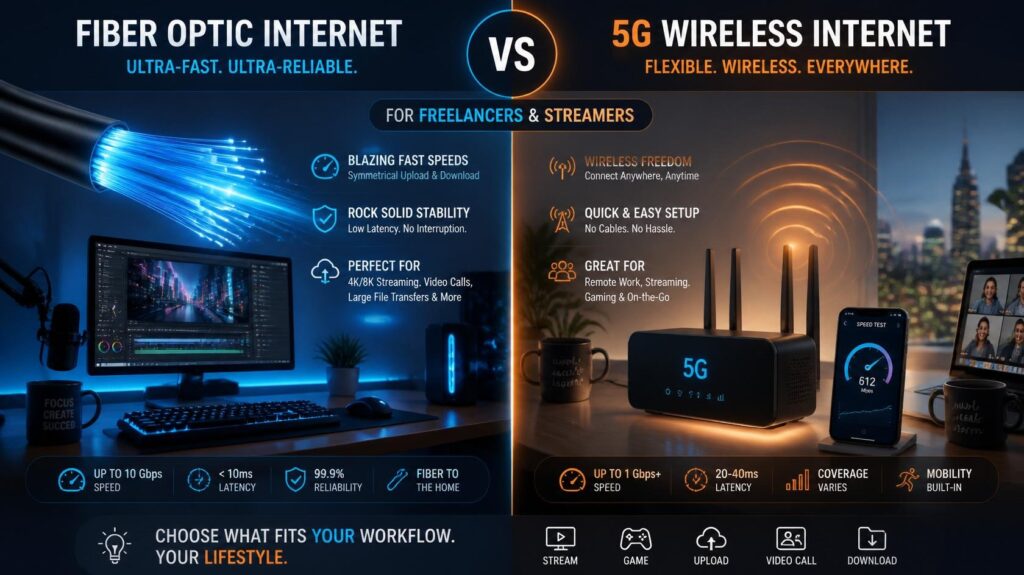
If you are working online, downloading files, or managing a website like Solutionodex, a stable internet connection is your backbone. But when setting up your home, you face a major choice: Should you get a physical Fiber Optic broadband line or rely on a wireless 4G/5G home device or SIM?
Let’s look at the absolute ground realities Fiber Optic vs 5G so you can choose the best one.
1. Fiber Optic :
Fiber Optic uses physical glass cables pulled directly into your home router. It is the gold standard for heavy internet users.
- Truly Unlimited Data: You can download heavy games, upload massive files, or stream 4K movies all day without worrying about data limits or extra charges.
- Low Ping and Latency: Fiber offers the lowest possible latency. If you do live streaming, video calls, or online gaming, low ping ensures zero lag.
- The Main Catch: It is tied to a physical wire. If a local construction crew accidentally cuts the cable on the street, your net goes dead until the technical team manually repairs it. Also, if power goes out and you don’t have a UPS for your router, the internet turns off.
2. 5G Home :
Wireless data routers run on cellular mobile networks. You just slide in a data SIM, power it on, and you are ready to go.
- Battery Power & Portability: Most wireless devices have internal batteries. When electricity goes out, your net keeps running for hours. Plus, you can pack it in your bag and work from anywhere.
- Zero Installation Hassle: No technicians drilling holes in your walls or running long wires. You buy the SIM, activate a bundle, and it works instantly.
- The Main Catch: Strictly limited packages (like 100GB or 150GB per month). If you stream heavy video content, your package can finish in days. Also, speeds can drop during evening peak hours when everyone in your neighborhood logs onto their phones.
3. The Final Verdict Fiber Optic vs 5g the dual setup :
For an ordinary user or digital professional, relying solely on wireless internet is highly risky due to expensive data limits and fluctuating speeds.
The Golden Rule: Use Fiber Optic as your primary connection for its speed and unlimited data. But always keep a Wireless Device as a backup.
In a setup where unexpected wire-cutting or long power breakdowns are common, this dual approach ensures your online business never suffers from any downtime.